Showing posts with label Traditional. Show all posts

Friday, 9 July 2021

Euro 2000 final - Rotterdam... or anywhere.


July 2 2020.  The day of the Euro 2000 final in Rotterdam.  A tournament that I was lucky enough to have tickets for.  Games in Bruges and Amsterdam for the group games whetted the appetite but tickets for the final was a once in a lifetime opportunity.  As the tournament progressed and Italy went further it crossed my mind that I could actually see the Azzuri in a major international tournament, and the final would be the icing on the cake.  

Just the small matter of beating the host nation Holland stood in the way, and the odds were heavily stacked against them.  It went to a penalty shootout and the Azzuri had done it... they were in a major final and I would be there.

A flight into Amsterdam then a train to Rotterdam gave enough time to spend the day soaking up the atmosphere in the city centre. The day had such a buzz about it and fans mingled all over the city, not many people asked about my Wigan Athletic shirt.  This was the pre Premier League era and  'Little Wigan' were still relatively unknown in Italian and French homes.

On the quest for food my mate and I walked past restaurant after restaurant until we literally reached the ‘Other Side of the Tracks’.  We had hit the roughest part of Rotterdam and hastily retreated before anyone spotted us, and made it back to the relative safety of the French fans.

We then took the tram to De Kuip ( and sat behind ex Arsenal striker Alan Smith), and went into the stadium to find our seats were in the Italian end. It was written in the stars...

France ,who had beaten Italy on penalties two years before in the World Cup quarter-finals on the way to winning the World Cup, once again stood in the way.


When the opposition is Italy, however, with their revolving door of gifted players and steely resolve, it was never going to be easy.

Managed by Dino Zoff, this Azzurri side was efficient and compact, staying true to the old-school Catenaccio tactics, having conceded only two goals so far in the tournament.  They weren’t about to roll over for anyone. 

Finals are often nervous affairs with neither side wanting to make an early mistake. The fear of losing can far outweigh the desire to win. Italy were underdogs, but they produced a far more expansive display than had been anticipated and dominated possession for large spells.  

The game started furiously. Italy had plenty of early pressure with Roma’s Marco Delvecchio proving a nuisance up-front. Henry provided the French threat, unleashing a couple of trademark snapshots before being on the receiving end of several friendly tackles from the Italian midfield, the chief culprit among them being Luigi Di Biagio. 

But in truth, the final didn’t come alive until the second half when, in the 53rd minute, a moment of genius blew the final wide open.   Delvecchio – who was selected by manager Dino Zoff at the expense of both Alessandro Del Piero and Filippo Inzaghi - broke the deadlock.

The goal was orchestrated by the man who had provided Italy’s offensive creativity throughout the tournament - Francesco Totti.  With his back to goal just outside of the penalty area, and with seemingly little in the way of passing possibilities, Totti paused and drew in two French defenders before executing an inch-perfect backheeled through-ball that set Gianluca Pessotto free on the wing with France’s offside trap completely fooled. Pessotto’s accurate cross was guided in on the volley by Delvecchio.


Now, Italy had to protect their lead for 35 minutes – and injury time – to win their first European Championship for 32 years.  Zoff sent on Del Piero to act as a focal point for counter-attacks, and his plan proved effective as the substitute was sent clear on goal twice in the closing minutes. 

The striker, however, was somehow unable to hit the net on either occasion, putting one shot wide and hitting the other straight at Fabian Barthez.  He was left to rue those misses when, 15 seconds from the final whistle, substitute Sylvain Wiltord slid a 94th-minute equaliser underneath a despairing Francesco Toldo.

With 13 minutes of extra time played, the Italy defence was caught uncharacteristically playing around with possession deep in their own half.   Robert Pires nipped in and danced past two tackles on the left wing before dinking in a cross from close to the byline.   Striker David Trezeguet, who had recently signed for Juventus to become Del Piero’s new team-mate, was to be the man who crashed home to win the match and break Italian hearts.

For many, this was unfairly heralded as a victory of good over evil due to Zoff’s reliance on conservative tactics – ones that had been so successful in getting the Azzurri to the final. 

20 years on, Del Piero himself still says “Losing in the final really hurts, but that’s how life goes, We then played against France [in the final who we’d played] on a number of other competitions, where we had the opportunity to get even. Losing that match certainly hurt."

Del Piero says that the defeat still rankles and remains at a loss to explain how Italy threw the match away.

“I don’t know, even now,” he says. “When you lose matches like that, and the opposition scores the equaliser in the last minute, and then scores the golden goal, it blows your mind. It is really awful, you don’t want to believe it.

"From then on we had to face reality: we came really close to realising a dream, which did not come true. You wake up the day after, and try to be the best because, despite the previous match, you have to think about the future."


The Euros haven't been kind to Italy since then.   They failed to get out of the group stages in 2004, losing out on goal difference to Denmark.  In 2008 they lost on penalties in the Quarter finals to eventual winners Spain and faced the Spanish again in the 2012 final, but lost 4-0 in Kiev.

Italy gained a smidgen of revenge on Spain by eliminating them from the 2016 tournament in the Round of 16, but a quarter final defeat on penalties to Germany sent the Azzuri home early again.


21 years on from the despair in Rotterdam, can Italy finally go one better and be called the Best Team in Europe?  It will be a very tough task but one which always brings the best out of the Azzuri.


Monday, 4 May 2020

Gironimo - Riding the Very Terrible 1914 Tour of Italy by Tim Moore


Tim Moore first came to my attention in 2003 as the author of the excellent French Revolutions, a book that frequently features in many lists of top 10 cycling-related books covering his attempt to cycle the full Tour route in 2000.

This book about the Giro is a highly entertaining account of an unnecessarily difficult journey on an unsuitable bike by an ill-equipped rider – but it is exactly those factors that provide the stories that make the book what it is. It has to be that way to provide the sense of adventure and the extreme fluctuations in fortune, so that we can join him in wondering at the “ludicrous enormity of the task”.

What inspires anyone to undertake such a project you wonder as you start reading his journey beyond the desire to gain enough material to write a book.

The journey involved riding the route of the 1914 edition of the Giro d’Italia, which was chosen because a Google search convinced Tim that it was the hardest ever cycling Grand Tour. The statistics would certainly support that, eighty-one riders started the 1,964-mile race.  A 36-hour rainstorm erupted soon after the start, washing out roads. Eight appalling stages later, the average length of each being roughly the distance from Lake District to London, eight riders crossed the finish line.

The race set records for the longest ever single stage distance and stage time amongst others, but there were plenty of other hardships: road conditions, team rivalries, weather conditions, injuries, and locals putting nails on the road. The cyclist-hating public threw tacks on the road, although cycling fans weren’t much better: They threw vegetables at racers they didn’t like. Riders, meanwhile, rode across Italy on a network of white gravel roads astride rudimentary machines ill-suited to swift mountain descents and without the benefit of today’s understanding of nutrition or technology.

Once the year had been determined, the task was to find an appropriate and authentic old school machine to complete the picture of “old fashioned grit and old-fashioned kit”. The story of Moore acquiring his initial choice of bike makes for great reading, but eventually he does take a slightly easier option and plumps for a more complete Hirondelle No.7 Course sur Route.  However, there are still plenty of opportunities for mechanical mishaps and running repairs.
Tim Moore in period dress


Not content to merely write about it, Moore assembled his period-correct bicycle and rode the route himself, chronicling his beleaguered progress as he chased the ghost of Alfonso Calzolari, the workhorse cyclist who won the 1914 Giro. (And then lived to the age of 95.)  This is not merely about suffering, but about reclaiming the lost pure heart of road racing, the one before energy gels, titanium and coldly efficient pacing of the modern-day peloton.

Those of us made of less stern stuff would have baulked at the prospect of recreating Calzolari’s 1914 victory, but Moore opted to coerce his period Hirondelle into some semblance of life, encouraged by the authenticity of the time.  Resplendent in a wool jersey, wool shorts, ancient leather shoes, white cap and a pair of goggles he set about his task, ready for all the trials and tribulations that would follow.


One such example comes from the cork brake pads that are required for the wooden rims: they don’t really work, and they don’t last long on mountain descents. One solution was to create new brake blocks along the way from the corks of Prosecco bottles. The book is full of little anecdotes like this, repairs ‘on the go’ as Moore had to find innovative ways to keep his bike going and roadworthy.

The bike...before it was built by the author

From the Alps to the Adriatic the pair relive the bike race in all its misery and glory, on an adventure that is by turns bold, beautiful and recklessly incompetent.


Thursday, 20 December 2018

An Italian Christmas


Christmas is a major holiday in Italy which means Italians celebrate lots of great, unique Christmas traditions!  Across Italy, Natale tends to be a family-centred holiday, a time to stay at home (and eat!) with loved ones. But customs also vary from city to city, from exactly which dishes are served, to when to open presents, making every region an interesting place to enjoy the holidays.

In other countries, Thanksgiving (or even Halloween!) signals the start of the Christmas season. In Italy, though, Christmas officially kicks off with the Day of the Immaculate Conception of Mary on December 8. This is when decorations go up (both on the streets and inside Italian homes) and when some Christmas markets start.

Decorations and huge Christmas trees can be found in main piazzas, like in front of the Colosseum or in Milan’s Piazza Duomo, and Babbo Natale (Father Christmas, the Italian version of Santa Claus) spreads holiday cheer.

This holiday, which is both religious and state-sanctioned (meaning lots of offices and businesses will be closed on December 8), doesn’t have anything to do with the day of Mary’s conception. Instead, it celebrates the day when the Church decided that Mary was born without having the stain of original sin.

The eight days before Christmas, also known as the Novena, are filled with singing traditional songs around the neighbourhoods.  If you’re in Rome, southern Italy or Sicily, keep an eye out for the zampognari, or bagpipe players—they travel from the nearby mountains to play their merry folklore carols.

Along with the fancy lights, wreaths and trees, presepi (nativity scenes) are displayed in many churches and piazzas. Crafting these ornate works of art by hand remains an artisanal tradition in many parts of the country. In Naples they are world-famous for their hand-made presepi.  

To prepare and purify their bodies for Christmas Day, Italians avoid meat on la Vigilia (Christmas Eve). Although the idea is to eat lean, most indulge on multiple courses of fish.

After the family dinner, many Italians head to midnight Mass at their local church to celebrate. (Some Romans even head to the Vatican for Mass with the Pope!).

But traditions vary from city to city: Up north, in Cortina d’Ampezzo in the Dolomite Mountains, thrill-seekers ski down the slopes with torches at midnight to welcome Christmas.

After the “light” Christmas Eve dinner, on Christmas Day, Italians invite their family and friends for a large lunch that usually goes on all day. Many save up to have the most lavish celebration possible, serving up traditional dishes like pasta in brodo (pasta in broth), roasts and traditional desserts like panettone

Celebrations often extend into December 26 with the national holiday of Santo Stefano; families get together and eat leftover Christmas dishes and sweets.

The official end of the Christmas season, though, isn’t until January 6—the Day of the Epiphany, and the twelfth day of Christmas. On the eve of the Epiphany, families usually prepare a large dinner to mark the end of the holiday season; children are given candy or coal (usually made of black sugar), depending on if they were naughty or nice. After January 6, you’ll see Christmas markets close and decorations start to come down.

Gifts are commonly exchanged on Christmas Day after lunch—sometimes with the belief that Jesus has delivered them.  But some smaller, northern Italian cities believe that the blind Saint Lucia brings gifts for children on December 13, so they open them that morning.


Other families may wait until January 6. The Epiphany is when la befana—a kind of “good witch” who is believed to have followed the wise men, but got lost—drops off presents. La befana is a particular tradition in Rome and Bologna, where the main piazzas often host fun activities for children; in Venice, locals believe that la befana arrives every year by boat! 

Regardless of when they open their presents, many Italians keep their wrapped gifts on display on the pyramid-shaped ceppo, along with candles and other decorations.

Among the traditions, customs and other rituals typical of Christmas season are:

  • The ceppo known as The Tree of Light is a wooden frame with a pyramid shape; it is several feet high and supports many shelves in its several tiers. The cepo has a manger scene and on the shelves above are placed small gifts of fruit, candy and presents. It is also beautifully decorated with pinecones, coloured paper, little candles and pennants. At the top is placed a star or a small doll.

  • Urn of Fate:This is a wrapped present for each family member. If you get a present with your name on it, you keep it; otherwise, you try again with other.

  • In the Vatican City, the people go to the square at noon on Christmas day to receive the Pope's blessing, he appears at his balcony.

  • Another tradition is the burning of the Yule log, which must stay alight until New Year's Day.

The most significant meal of the Christmas Day is the lunch or il pranzo. In the northern Italy dishes such as: 

  • lo zampone - the skin of the lower pig leg, including the toe little bones, filled with minced meat and sausages
  • il cotechino - pig's foot stuffed with spiced minced meat
  • Sausages made of pig's intestines
  • Smothered in lentils
  • Turkey stuffed with chestnuts
  • Lamb is also enjoyed with mashed potato and lentils.
In Rome and the southern Italy the traditional dish of Christmas Eve is "Capitone" a big female eel, roasted, baked or fried. On the table we also can find delicacies such as:
  • Tortellini in chicken stock
  • Crostini with liver pâté
  • l’agnello - lamb accompanied with vegetables, mashed potato and lentils.


Desserts such as: 
  • torrone - Nougat
  • il panettone - the Milanese fruitcake filled with candied fruit
  • Gold bread - the traditional cake
  • il pandoro - similar to il panettone, only without fruits or raisins
  • il panforte - Gingerbread with hazelnuts, honey and almonds
The traditional drinks are:
  • Vin brule - mulled wine
  • Bombardino - Italian version of eggnog
  • Punch of rum, mandarin and orange flavours

    Buon Natale e Felice Anno Nuovo

Tuesday, 28 February 2017

The Story of Calcio Storico


Calcio fiorentino (also known as calcio storico "historic football") is an early form of football that originated in 16th-century Italy. Once widely played, the sport is thought to have originated in the Piazza Santa Croce in Florence. Here it became known as the giuoco del calcio fiorentino ("Florentine kick game") or simply calcio; which is now also the name for association football in the Italian language. The game may have started as a revival of the Roman sport of harpastum.

Calcio was reserved for rich aristocrats who played every night between Epiphany and Lent. Even popes, such as Clement VII, Leo XI and Urban VIII were known to play the sport in Vatican City. The games were known to get violent as teams vied with each other to score goals. In a historically famous occasion, the city of Florence held a match on February 17, 1530, in defiance of the imperial troops sent by Charles V, as the city was under siege. In 1574 Henry III of France attended a game of "bridge fighting" – put on in his honour during a visit to Venice; the king is recorded as saying: "Too small to be a real war and too cruel to be a game".

Over the centuries, there have been numerous sources that testify to the presence of the Calcio Storico Fiorentino as early as the 15th century. The Florentines usually found themselves in the streets of the city or in the main squares starting matches like the ones you can see today during the re-enactment. The occupation of public spaces by young people was regulated, later, to avoid disturbances and problems in the organisation of the city; in this way the squares became the officially designated places to play football. The balls were often handmade with the outside made of leather and the interior filled with rags or sometimes with animal bladders filled with air.

Throughout the Medici age, what had been a popular pastime was reorganised and became a discipline practiced by the noble classes. Florence began to be the scene of numerous clashes between the people, often divided into teams, and headed by the most illustrious personalities of the Florentine families. The noble character gave rise to the term of Football in Livery, referring to the livery and elegant clothes worn by the players. The official rules of calcio were published for the first time in 1580 by Giovanni de' Bardi, a Florentine count.

The period designated for the games was generally that of Carnival; the famous game on 17th February 1530 in particular went down in history, when Florence was besieged by the army of Charles V. The Florentines, despite the seriousness of the situation, started nonetheless the Calcio Florentino game in Piazza Santa Croce!

The Calcio Storico Fiorentino players could, therefore, take revenge on those nobles who lived the game as an aesthetic moment in which to show off their precious clothes thereby losing the recreational and authentic aspect from which this street sport was born. The citizens of the aristocratic families, in fact, organised the games in the most important parts of Florence and added that a procession in honour of the race. Residents were invited to attend as spectators to watch from the stands built around the city square. All the districts of the Calcio Storico Fiorentino participate in the parade, although the final only includes two teams.


Piazza Santa Croce


Interest in Calcio  waned in the early 17th century. However, in 1930 it was reorganized as a game in Kingdom of Italy under Mussolini. The game was widely played by amateurs in streets and squares using handmade balls made of cloth or animal skin. Today, three matches are played each year in Piazza Santa Croce in Florence in the 3rd week of June. A team from each quartiere of the city is represented:

  • Santa Croce / Azzurri (Blues)
  • Santa Maria Novella / Rossi (Reds)
  • Santo Spirito / Bianchi (Whites)
  • San Giovanni / Verdi (Greens)

After playing each other in two opening games, the two overall winners go into the final which occurs each year on June 24; this is San Giovanni (St. John)'s Day, the Patron Saint of Florence. The modern version of calcio allows tactics such as head-butting, punching, elbowing, and choking but sucker punches and kicks to the head are banned. It is also prohibited for more than one player to attack an opponent. Any violation leads to being thrown out of the game.

Matches last 50 minutes and are played on a field covered in sand, twice as long as it is wide ( approximately 80x40 meters ). A white line divides the field into two identical squares, and a goal net runs the width of each end. Each team has 27 players and no substitutions are allowed for injured or expelled players. The teams are made up of four Datori indietro (goalkeepers), 3 Datori innanzi (fullbacks), 5 Sconciatori (halfbacks), 15 Innanzi o Corridori (forwards). The Captain and Standard Bearer's tent sits at the centre of the goal net. They do not actively participate in the game, but can organise their teams and sometimes act as referees, mainly to calm down their players or to stop fights.

The referee and his six linesmen referee the match in collaboration with the Judge Commissioner, who remains off the field. The referee, above everyone else, is the Master of the Field. He makes sure the games runs smoothly, stepping into the field only to maintain discipline and reestablish order in case of a fight on the field.

The game starts when the Pallaio  throws and kicks the ball towards the centre line, then at the first whistle and at first the ball rests on field, 15 forwards or Corridori begin fighting in a wild mixed martial arts match- punching, kicking, tripping, hacking, tackling, and wrestling with each other in an effort designed to tire opponents' defences, but which often descends into an all-out brawl, trying to put, pin down, force to submit as many players possible; once there are enough incapacitated players, the other teammates come and swoop up the ball and head to the goal. Then followed by a small cannon firing; the shot announces the beginning of the contest.

From this moment on, the players try by any means necessary to get the ball into the opponents' goal also called caccia. The teams change sides with every caccia or goal scored. It's important to shoot with precision, because every time a player throws or kicks the ball above the net, the opposing team is awarded with half a caccia. The game ends after 50 minutes and the team which scored the most cacce wins.

The prize is also interesting, because along with the Palio di Siena, the winning team used to receive a Chianina, a type of cow. However, the prize has been reduced to a free dinner for the winning team; the players earn no other compensation.   

More popular than ever, Calcio Storico Fiorentino has kept the form of a historical event amongst the most important ones of the city and region.


Saturday, 6 June 2015

Where are the members of the Azurri Italia 90 squad? Roberto Mancini


Roberto Mancini was born on 27 November 1964 in the small town of Lesi, in the Marche region of central Italy. Like most Italians, he was raised a Roman Catholic and his life revolved around religion and football, passions which remain today.

As a player Mancini was best known for his time at Sampdoria, where he played more than 550 matches and helped them win the Serie A title along with four Coppa Italia trophies and the European Cup Winners’ Cup. 
He was capped 36 times by Italy, making his last appearance in 1994.  Mancini started his career at Bologna, making his debut back in 1981 before a big money move to Sampdoria in 1982 followed.  He also played for Lazio, where he won another Scudetto, Cup Winners’ Cup and two more Coppa Italia’s. He finished his playing career in England with a brief stint at Leicester City
Towards the end of his playing career, he showed signs that he would end up in management when he started giving team talks at half-time. Coach, Sven Goran Eriksson, was a huge influence on ‘Mancio’, playing under him at both Samp and Lazio and he became the Swedes assistant at theBiancocelesti near the end of his playing career.
Mancio joined Leicester City on loan in January 2001, but by early February he was given leave of absence, citing personal reasons. He telephoned the club and informed them he would not be returning to England as he had been offered the head coach position at Fiorentina.  Despite his brief stay in the Premier League he cites his time at Leicester City as the period during which he fell in love with the English game, and which later prompted him to accept the job at Manchester City.
Sadly for Mancini, he never truly replicated his club form at international level and he struggled to cement a regular starting spot for the Azzurri. He won 36 caps for his country, but only scored four goals in return. He made his senior international debut in 1984 against Canada and he would continue to represent Italy for ten years. Despite being an influential figure for Samp at the time, Mancini was a non-playing member of the Azzurri squad at Italia 90, kept out of the side by the striking prowess of his Blucerchiatistrike partner, Gianluca Vialli, as well as Salvatore Schillaci and new kid on the block Roberto Baggio.
His failure to play any part in Italia ‘90’ has lingered with ‘Mancio’ throughout his career. Even now as a coach he still struggles to understand Azeglio Vicini’s decision. ‘I didn’t even play for ten minutes” fumed Mancini. “Not even in the third place game. I still don’t understand the decision.”
Mancini’s international career ended after a dispute with national team coach Arrigo Sacchi, his assertive personality leading him to become frustrated with not being guaranteed a first team place at the 1994 World Cup. In truth it was a similar story to Italia ’90’ for the assertive Italian, the fierce competition for places hindering his opportunities with players like Gianfranco Zola, Giuseppe Signori, Roberto Baggio and later Francesco Totti and Alessandro Del Piero hastening his self-imposed exile from the Azzurri.
An elegant and skilful player, Mancini was also renowned for his flair, outstanding technique, ball control, and dribbling ability, as well as his tactical intelligence. He frequently stood out because of these attributes. But he wasn’t just a talented forward; he also possessed impressive leadership skills.
Mancini’s first head coaching role was at Fiorentina, aged only 35-years-old. Despite his inexperience he won the Coppa Italia with the Viola but left soon afterwards with the club facing bankruptcy. He took over as head coach at Lazio, where again he inherited financial constraints and was forced to lose a number of key players. Despite limited resources during his two season tenure, he still managed to guide the club to Coppa Italia success, a competition of which he was quickly growing fond.
In 2004, Mancini was given the chance to manage Inter, a major club with no shortage in financial resources. During his first spell at the Nerazzurri, the club won three consecutive Serie A titles. It was a record that meant Mancini became Inter’s most successful coach in 30 years.
Mancini left the Benemata in 2008, replaced by Jose Mourinho as the Inter board continued their chase of the Holy Grail – the Champions League. After taking a year out of football, Mancini was appointed as Manchester City manager in December 2009. He quickly instilled a winning culture and guided the club to Champions League football and the FA Cup in his first full season in charge. The following campaign he led City to their first league title in 44 years, a success secured in one of the most dramatic final days in Premier League history, Mancini’s men scoring two goals in injury time to complete an enthralling 3-2 comeback against Queens Park Rangers.
Credit for this victory, however, is apparently due to divine intervention.  As the season was reaching a tense finish, Mancini took time out to visit the religious pilgrimage site, Medjugorie, in Bosnia Herzegovina. ‘Mancio’ stated that it was this pilgrimage that turned the title in his favour.
The following season was turbulent for the former Samp man, as City failed to retain the title, losing out to rivals Manchester United, and also losing the FA Cup final to Wigan Athletic. He was sacked the following week however the man showed his class after paying for a full-page advert spread in the Manchester Evening News to say farewell and to thank the club’s fans. The act was reciprocated in the Gazzetta dello Sport by Manchester City supporters.
In September 2013, Mancini signed a three-year contract with Galatasaray taking over from the previous coach Fatih Terim. However, the stylish coach barely lasted a year in Turkey despite winning the Turkish Cup. Mancini returned to Inter for a second spell in November 2014, replacing Walter Mazzarri at the helm and it seems he is slowly turning the Nerazzuri’sfortunes around.

Mancini has won a total of 25 trophies; 13 as a player and 12 as a coach. Incredibly, every season he has coached between 2002 and 2013, the Italian has reached a semi-final of a major cup competition. He holds a number of records including reaching the most consecutive Coppa Italia finals from 2004 to 2008, the first with Lazio and the rest with Inter.
Mancini may not have seen a minute of playing time at Italia ‘90’ however he has since carved out an extremely successful career and the story of ‘Mancio’ is far from over…

@insearchofluca

Thursday, 28 August 2014

The 'Team X' Files


The Italian football season restarts this weekend amid turmoil and a lot of confusion.  For once this isn’t a Serie A problem.  This year it is the turn of Serie B.

The season begins with only 21 teams after Siena’s liquidation earlier in the summer.  

The season’s fixture list was finally unveiled on Wednesday and organisers were forced to refer to the missing club as ‘Team X’.

'Team X’ were due to stage the opening game of the competition at home to Latina on Saturday evening, although that will now be postponed.
The league was initially cut to 21 teams as part of a long-term plan to eventually reduce it to 20 teams.

However, Novara, the highest placed of the four teams relegated last season, protested and an Italian Olympic Committee (CONI) tribunal ruled that Serie B must continue with 22 teams this season.

The Italian Football Federation (FIGC) was asked to find the 22nd team and declined to automatically include Novara as they are among the clubs who have had points deducted in the last two years over the Calcioscommesse match-fixing scandal.

Instead, the FIGC chose to use a complex ranking system to choose a team from among those who were either relegated from Serie B last season or finished in the top half of the third-tier Lega Pro.

The FIGC will award points based on each team’s position in the league last term, their city’s “sporting tradition” and the team’s average attendances over the past five seasons.
It appears that Pisa and Juve Stabia are the best placed teams, although Novara, who would have finished top of the rankings, have appealed against their exclusion.

At least 12 teams are in the running for the vacant spot which means with the season days away none of them know which division they will play in.
The FIGC is expected to announce its decision on Thursday, although that could be postponed by further appeals against clubs who think they have been hard done by.

At the time of writing the 21 teams due to compete are –
Avellino, Bari, Bologna, Brescia, Carpi, Catania, Cittadella, Crotone, Frosinone, Latina, Livorno, Modena, Perugia, Pescara, Pro Vercelli, Spezia, Ternana, Trapani, Varese, Virtus Entella and Virtus Lanciano…and Team X!!

Unsurprisingly, ahead of the new campaign, the bookmakers have Catania, relegated last season from Serie A, as slight favourites to win the title ahead of the two other relegated sides Bologna and Livorno.  It is hard to see past these three sides for promotion, but they will face stiff competition from sides like Bari, beaten in the Promotion Play Offs last season, and Pescara.

It could be a long season for Virtus Entella and Pro Vercelli.  Entella, last season’s Lega Pro Prima Divisione champions ,will compete in Serie B for the first time.  Pro Vercelli are also back after promotion.  This famous club has 7 Scudettos to their name, sadly the last title was won in 1922. 

As the season unfolds, there are bound to be many twists and turns. Who knows, Team X could be the team to gain promotion to Serie A.
Ciao

Follow me on Twitter @insearchofluca

Tuesday, 2 July 2013

Palio di Siena


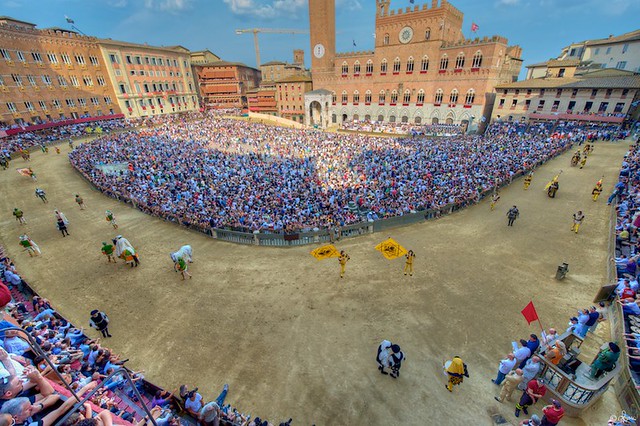
The Palio di Siena, known locally as Il Palio, is one of the most important folkloric events in Italy.  It is a horse race held twice a year in the Piazza del Campo, Siena.  Ten horses and riders represent ten of the seventeen contrade (or city wards).


The Distinguished Collegiate Church of Santa Maria in Provenzano, Siena, is dedicated to the Visitation of the Blessed Virgin Mary to St. Elizabeth.  On July 2, formerly the feast of The Visitation, the Sienese celebrate the first PalioPalio di Provenzano in her honour.


The second event, held on August 16, coincides with the feast of The Assumption.  This second Palio is named Palio dell'Assunta, in honour of the Assumption of Mary.


With several hundred participants, a magnificent pageant (the Corteo Storico) precedes the race.  A formally choreographed march, it commemorates the ancient customs, institutions and greatness of the Republic of Siena.  Seventeen pairs of flag bearers (Alfieri) are positioned at various points in the Piazza and, in synchrony, perform a spectacular flag-waving exhibition culminating with the flowing of the flag.  Just before the pageant, the carabinieri (national military police of Italy) on horseback, wielding swords, demonstrate a mounted charge around the track.  They take one lap at a walk, in formation, and a second at a gallop before exiting out of Piazza del Campo.


Flag bearers prior to the race - Image courtesy of www.flickr.com

The Pageant - image courtesy of incontrastudenti.wordpress.com


The race itself circles the Piazza del Campo three times and usually lasts no more than 90 seconds.  Jockeys, who ride the horses bareback, are frequently thrown off while making the treacherous turns in the piazza, and it is not unusual to see unmounted horses finishing the race without their jockeys.  As it is the horse that represents the contrade and not the jockey, an unmounted horse may win the race!


Palio in full flow - Image courtesy of www.hotelathena.com

The Palio takes place over four days, with the race taking place on the fourth day.  The first day is for the "Tratta", or the drawing of the lots and assignment of the horses to each of the Contrade.

Before the official race there are six trial runs or heats, one in the morning and one in the afternoon.  The fifth trial, the one run the evening prior to the official Palio, is called the "prova generale" (or general trial) while the last takes place the morning of the race.  This is called "provaccia" (or bad trial) due to the little effort the jockeys put into it in order to avoid tiring the horses too much.

The emblems and colours of each Contrade are grouped into either "Terzi" or "Terzieri" (many centuries again the town was divided into three sections.  These were known as "Terziere di Città", "Terziere di San Martino" and "Terziere di Camollia").  Flags and emblems displayed along the street easily identify each ward.  Much like street signs, corners often designate the entrance into a different contrada.


The Contrada


The seventeen Contrada are -

Terziere di Città


AQUILA (Eagle) a double-headed eagle with imperial symbols. Yellow with black and blue bands.
CHIOCCIOLA (Snail) a snail. Yellow and red with blue bands.
ONDA (Wave) a swimming dolphin wearing a crown. White and blue.
PANTERA (Panther) a rampant panther. Red and blue with white bands.
SELVA (Forest) a rhinoceros bearing a huge tree hung with hunting implements. Green and orange-yellow with white bands.
TARTUCA (Tortoise) a tortoise. Yellow and blue.
Terziere di San Martino
CIVETTA (Owl) an owl. Black and red with white bands.
LEOCORNO (Unicorn) a unicorn. White and orange-yellow with blue bands.
NICCHIO (Shell) a seashell. Blue with yellow and red bands.
TORRE (Tower) an elephant with a tower on its back. Dark bordeaux red with white and blue bands.
VALDIMONTONE or MONTONE (Ram) a rampant ram. White and yellow with red bands.
Terziere di Camollia
BRUCO (Caterpillar) a caterpillar. Yellow and green with blue bands.
DRAGO (Dragon) a flying dragon. Red and green with yellow bands.
GIRAFFA (Giraffe) a giraffe. White and red.
ISTRICE (Porcupine) a porcupine. White, red, black and blue bands.
LUPA (She-Wolf) the Roman She-Wolf suckling the twins. Black and white with orange-yellow bands.
OCA (Goose) a crowned goose with the cross of Savoia round its neck. White and green with red bands.


The race starts off in the "Mossa", an area set up on the piazza defined by two long pieces of thick rope. The "Mossiere" (starter) then calls the Contrade forward in the order in which they were drawn and checks that the assigned positions are respected.  The first nine Contrade take up their assigned positions in the area between the two ropes, while the last one, the tenth, enters this area at a running gallop, which signals the start of the race.


Before the start - Image courtesy of commons.wikimedia.org


In the event of a 'false start' (this is the case if the jockeys are not in their assigned spots), a shot goes out to signal the jockeys to get back into their positions.  This starting phase within the "Mossa" is more complicated than it seems, as the space is small and the horses are right next to each other.  Rivalries run deep within the Contrade and competition is high and the worst result is to see the "enemy" Contrada win the race.

The horses must overcome dangerous points in the race, such as the very narrow curve of San Martino, where collisions between the wall and between horses have led to many falls in the past (the reason why many animal activists oppose the Palio).

The winning Contrada receives the Drappellone, (or large drape, a large painted canvas each year designed and created by a different artist and which the winning contrada displays in their own museum).  Then the victorious Contrada members head towards the Church of Provenza (after the July race) or towards the Duomo (after the August race) for the Te Deum (or prayer of thanks).

Victory usually coincides with a months-long celebration for the winning ward.  The 'loser' in the race is considered to be the contrada whose horse came second, not last.

The Palio differs from "normal" horse races in that part of the game is for the wards to prevent rival contrade from winning.  Few things are forbidden to the jockeys during the race; for instance, they can pull or shove their opponents, hit the horses and each other, or try to hamper other horses at the start.


The winner - Image courtesy of online.wsj.com


The Palio di Siena is more than a simple horse race.  It is the culmination of ongoing rivalry and competition between the contrade.  The lead-up and the day of the race are invested with passion and pride.  Formal and informal rituals take place as the day proceeds, with each contrada navigating a strategy of horsemanship, alliances, and animosities.  


The Palio, along with the plumes, remains the property of the contrada.  The plate is returned to the city of Siena before the two Palii of the following year, after the date and the name of the victorious contrada are inscribed on its back.  There is one silver platter for the Palio in July and another for the August Palio.  The plates are replaced approximately every ten years.


The value of the banner is unique, because it represents a particular historical period of the city of Siena.  The palii often reflect the symbols of the various governments that have presided at various times, including the crest of the grand duchy of Lorraine, the crest of the Grand Dukes of Tuscany, the crest of the Kingdom of Savoy of Italy, symbols from Fascist Italy, and most recently, imagery of the Republic.


The Palio is much more than a simple event for the Sienese, it is a significant part of their lives since the time of their birth.  Each person belongs to a Contrada, participates in the life of the Contrada and the organization of the Palio throughout the entire year. The Sienese live the Palio with great passion and this is evident during the races.


The winner of the July 2013 race was Oca (Goose).   This was their third victory this century and their 65th overall,  Oca is the most successful Contrada by far.  The winner of the August 2013 race was Onda (Wave), their second win this century.

2014 promises to be another chaotic and exciting race. 

2014 winners - Drago and Civetta
2015 winners - Torre and Selva
2016 winners - Lupa won both Palio.
2017 winners - Giraffe and Onda
2018 winners - Drago and Tartuca
2019 winners - Giraffe and Selva

Follow me on Twitter @insearchofluca

Sources:  http://www.comune.siena.it