The Palio di
Siena, known locally as Il Palio, is one of the most important folkloric events in Italy. It is a horse race held twice
a year in the Piazza del Campo, Siena. Ten horses and riders represent ten of the seventeen
contrade (or city wards).
The Distinguished Collegiate Church of Santa Maria in Provenzano, Siena, is dedicated to the Visitation of the Blessed Virgin Mary to St. Elizabeth. On July 2, formerly the feast of The Visitation, the Sienese celebrate the first Palio, Palio di Provenzano in her honour.
The second event, held on August 16, coincides with the feast of The Assumption. This second Palio is named Palio
dell'Assunta, in honour of the Assumption of Mary.
With several hundred participants, a magnificent
pageant (the Corteo Storico) precedes the race. A formally choreographed march, it commemorates the ancient customs, institutions and greatness of the Republic of Siena. Seventeen pairs of flag bearers (Alfieri) are positioned at various points in the Piazza and, in synchrony, perform a spectacular flag-waving exhibition culminating with the flowing of the flag. Just before
the pageant, the carabinieri (national military police of Italy) on horseback, wielding swords,
demonstrate a mounted charge around the track. They take one lap at a walk, in
formation, and a second at a gallop before exiting out of Piazza del Campo.
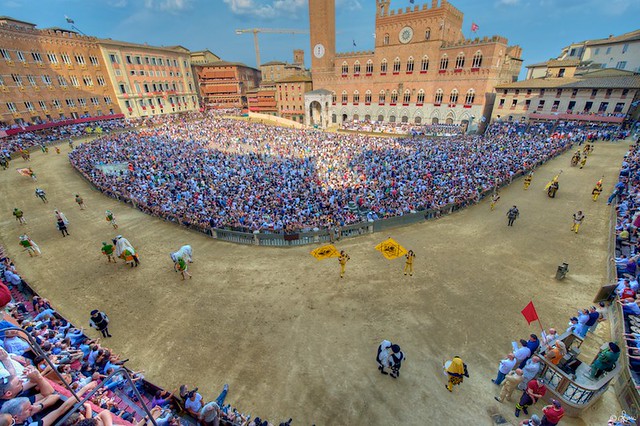 |
| Flag bearers prior to the race - Image courtesy of www.flickr.com |
 |
The Pageant - image courtesy of incontrastudenti.wordpress.com
|
The race itself
circles the Piazza del Campo three times and usually lasts no more than 90 seconds. Jockeys, who ride the horses bareback, are
frequently thrown off while making the treacherous turns in the
piazza, and it is not unusual to see unmounted horses finishing the race
without their jockeys. As it is the horse that represents the contrade and not the jockey, an unmounted horse may win the race!
 |
| Palio in full flow - Image courtesy of www.hotelathena.com |
The Palio takes place over four days, with
the race taking place on the fourth day. The first day is for the "Tratta", or the drawing of the lots and assignment of the horses to each of the
Contrade.
Before the official race there are six trial runs or
heats, one in the morning and one in the afternoon. The fifth trial, the one
run the evening prior to the official Palio, is called the "prova
generale" (or general trial) while the last takes place the morning of
the race. This is called "provaccia" (or bad trial) due to the
little effort the jockeys put into it in order to avoid tiring the horses too
much.
The emblems and colours of each Contrade are grouped into either "Terzi" or "Terzieri" (many centuries again the town was divided into three sections. These were known as "Terziere di Città", "Terziere di San Martino" and "Terziere di Camollia"). Flags and emblems displayed along the street easily identify each ward. Much like street signs, corners often designate the entrance into a different contrada.
 |
| The Contrada |
The seventeen Contrada are -
Terziere di Città
AQUILA (Eagle) a double-headed eagle with imperial symbols. Yellow with black and blue bands.
CHIOCCIOLA (Snail) a snail. Yellow and red with blue bands.
ONDA (Wave) a swimming dolphin wearing a crown. White and blue.
PANTERA (Panther) a rampant panther. Red and blue with white bands.
SELVA (Forest) a rhinoceros bearing a huge tree hung with hunting implements. Green and orange-yellow with white bands.
TARTUCA (Tortoise) a tortoise. Yellow and blue.
Terziere di San Martino
CIVETTA (Owl) an owl. Black and red with white bands.
LEOCORNO (Unicorn) a unicorn. White and orange-yellow with blue bands.
NICCHIO (Shell) a seashell. Blue with yellow and red bands.
TORRE (Tower) an elephant with a tower on its back. Dark bordeaux red with white and blue bands.
VALDIMONTONE or MONTONE (Ram) a rampant ram. White and yellow with red bands.
Terziere di Camollia
BRUCO (Caterpillar) a caterpillar. Yellow and green with blue bands.
DRAGO (Dragon) a flying dragon. Red and green with yellow bands.
GIRAFFA (Giraffe) a giraffe. White and red.
ISTRICE (Porcupine) a porcupine. White, red, black and blue bands.
LUPA (She-Wolf) the Roman She-Wolf suckling the twins. Black and white with orange-yellow bands.
OCA (Goose) a crowned goose with the cross of Savoia round its neck. White and green with red bands.
The race starts off in the "Mossa",
an area set up on the piazza defined by two long pieces of thick rope. The
"Mossiere" (starter) then calls the Contrade forward in
the order in which they were drawn and checks that the assigned positions are
respected. The first nine Contrade take up their assigned positions in
the area between the two ropes, while the last one, the tenth, enters this area
at a running gallop, which signals the start of the race.
 |
| Before the start - Image courtesy of commons.wikimedia.org |
In the event of a 'false start' (this is the case
if the jockeys are not in their assigned spots), a shot goes out to signal the
jockeys to get back into their positions. This starting phase within the "Mossa"
is more complicated than it seems, as the space is small and the horses are
right next to each other. Rivalries run deep within the Contrade and
competition is high and the worst result is to see the "enemy"
Contrada win the race.
The horses must overcome dangerous points in the race,
such as the very narrow curve of San Martino, where collisions between the wall
and between horses have led to many falls in the past (the reason why many
animal activists oppose the Palio).
The winning Contrada
receives the Drappellone, (or large drape, a large painted canvas each year designed and created by a different artist and which the winning contrada displays in their own museum). Then the victorious Contrada members head
towards the Church
of Provenza (after the July race) or towards the Duomo (after the
August race) for the Te Deum (or prayer of thanks).
Victory usually
coincides with a months-long celebration for the winning ward. The 'loser' in the race is considered to be the contrada
whose horse came second, not last.
The Palio
differs from "normal" horse races in that part of the game is for the
wards to prevent rival contrade from winning. Few things are forbidden to the jockeys during the race; for
instance, they can pull or shove their opponents, hit the horses and each
other, or try to hamper other horses at the start.
 |
| The winner - Image courtesy of online.wsj.com |
The Palio di
Siena is more than a simple horse race. It is the culmination of ongoing
rivalry and competition between the contrade. The lead-up and the day of
the race are invested with passion and pride. Formal and informal rituals take
place as the day proceeds, with each contrada navigating a strategy of
horsemanship, alliances, and animosities.
The Palio,
along with the plumes, remains the property of the contrada. The plate
is returned to the city of Siena before the two Palii of the following year,
after the date and the name of the victorious contrada are inscribed on
its back. There is one silver platter for the Palio in July and another for the
August Palio. The plates are replaced approximately every ten years.
The value of
the banner is unique, because it represents a particular historical period of
the city of Siena. The palii often reflect the symbols of the various
governments that have presided at various times, including the crest of the
grand duchy of Lorraine, the crest of the Grand Dukes of Tuscany, the crest of
the Kingdom of Savoy of Italy, symbols from Fascist Italy, and most recently,
imagery of the Republic.
The Palio is much more than a simple event for the
Sienese, it is a significant part of their lives since the time of their
birth. Each person belongs to a Contrada, participates in the life of the
Contrada and the organization of the Palio throughout the entire year. The
Sienese live the Palio with great passion and this is evident during the races.
The winner of the July 2013 race was Oca (Goose). This was their third victory this century and their 65th overall, Oca is the most successful Contrada by far. The winner of the August 2013 race was Onda (Wave), their second win this century.
2014 promises to be another chaotic and exciting race.
2014 winners - Drago and Civetta
2015 winners - Torre and Selva
2016 winners - Lupa won both Palio.
2017 winners - Giraffe and Onda
2018 winners - Drago and Tartuca
2019 winners - Giraffe and Selva


