Showing posts with label Turin. Show all posts

Wednesday, 12 October 2016

Joe Baker - A Brit Abroad


Joe Baker


 Joe Baker was an English international footballer. He was the first player to have played for England without having previously played in the English football league system and for scoring over 100 goals in both the English and Scottish leagues.

Born in Liverpool to Scottish parents on 17 July 1940, Baker’s life on the move began almost from birth.  The son of a sailor, he moved from Merseyside to the Scottish border town of Wishaw, Lanarkshire when he was six weeks old.

He remained in Scotland for the remainder of his childhood - and many would claim his international affinity would have been more closely suited to the tartan of Scotland than England.

He spoke with a broad Scottish accent, but Baker’s club career could actually have begun in England. He spent a month on trial at Chelsea but was not offered a permanent contract.

After that Baker returned to Scotland and in 1957 joined Edinburgh side Hibernian, where he remained for four years.

It was during that first period that Baker decided to move on from Hibs and experience football in another league – but it would not be in England.

Instead, the diminutive forward opted for a move to Italy and Serie A, where he joined fellow Brit, and some may say ‘fellow Scot’, Denis Law at Torino.

In 1961, Baker was transferred to Torino for £75,000, after the Hibs board refused to give him a £5 wage increase from his existing wage of £12 a week.  Despite scoring a winning goal in a Turin derby match against Juventus, his time at the Italian club was short and almost ended in tragedy. Baker was involved in a serious car crash, which meant that he needed life-saving surgery and spent over a month on a drip feed.  
It was a generally unhappy spell as Baker did not like the press intrusion, which meant that he and teammate Denis Law spent most of their time in their Turin apartment.


Law, Peronace and Baker


 It is fair to say the time spent in Italy was on mixed for Baker and he struggled to make an impact.

There were off-the-field incidents with paparazzi – including one infamous incident where he knocked one unfortunate member of the press into a Venetian canal.  His tumultuous time in Turin came to an end in 1962

It was a prolific career for the striker, who upon leaving for Torino in 1961 had notched up an impressive tally of 102 in 117 league games, and 159 goals in all competitions – and famously once scoring all four goals in a 4-3 Scottish Cup victory over city rivals Hearts.

In later years he represented Nottingham Forest, Sunderland, Hibernian again and Raith Rovers – as well as two brief stints in charge of Albion Rovers.

Baker passed away in 2003 at the age of 63.
 

Below is an article, written by Baker, for Charles Buchan’s Football Monthly, in December 1961. In it, he talks about his experience in Italy and the reasons he went there.

My Life in Italy by Joe Baker

“JOHN CHARLES, apparently, is thinking of making this his last season in Italian football. Well, big John has had a good run there, and perhaps he has had enough. Jimmy Greaves? Somehow things don’t seem to have worked out for him. I had hoped he would settle in as Denis Law and I have done. Our combined verdict on this still-new-to-us life in Italy is … it’s terrific!

Perhaps we have been lucky. But even when I saw the advantage of moving to Italy—mostly financial, of course—I never dreamed it would be anything like it is. Where in Scotland—or England—would a team get home from an away game at 2am…to find a packed railway platform with thousands, yes, thousands, of fans waiting to greet them? It happened to us.

I’ve never seen anything quite like it. Or where would you find, for an ordinary club practice match, more than 7,000 fans yelling their heads off at a goal in such a game? That’s Italy … and Italian Soccer fans!

Italian football? Well, I’m living and learning and, having had one sobering taste of discipline, I can say I’m really beginning to understand the differences between the way we played it at home and how I have to now.

What one has to get used to, particularly as a centre-forward is much closer marking than at home. I call the wing-half, left or right, who has to mark me, the “gluepot”.

The system in Italy is for the centre-half to lie behind the entire defence, on patrol for trouble. Thus I have a wing-half covering me.

Italian football is rather more defensive than ours. This is especially true of visiting teams for the idea is to try to hold a point. That is a generalisation, teams do vary in style to some extent. I don’t mind the closer marking now, particularly as alongside me there is Law.

If I can lure my “shadow” for a “walk” it creates a space which Denis can move into with the result he alone can bring.

I suppose the recent scenes in the match between Roma and Birmingham have had people at home throwing up their hands and exclaiming: “Those foreigners, the way they play football!”

I wasn’t at that game. That same night I was playing for Torino against Manchester City at Maine Road where, l am proud to say, the Baker brothers, Gerry for City and I, got four goals between us, with a crowd of relatives looking on.

Let me say this about the differences in the game back home and in Italy. It took me some time to get over the checking and obstruction. But you do NOT hope to get the crash-bang tackling which we so readily accept back home.

And you do NOT get the injuries, at least nothing like the serious ones, as you do in British football. A player breaking a leg in Italy is unheard of, yet it is almost a weekly happening at home. So, rules or no rules, there is something to be said for the way the Continental game is played.

I was niggled when I first met the obstruction tactics. I got to such a pitch that, against Lanerossi, I wasn’t able to control myself. To my regret I took a swing at an opponent and was sent off for the automatic two-game suspension. May I add that I was more than normally provoked.

Until that day I had never had a referee even question my game, wherever I had played. It was a bitter lesson, but I learned from it.

Training in Italy is very different from that at home, and nothing like as hard. We have the heat to contend with, of course, and it would be foolish to train as I used to do. But discipline is far more strict.

We train mostly in the late afternoon. We can go to the ground in the morning for showers, but the main session begins later. It comes easy to me. No lapping. When you run it is part of an exercise. And there is far more ball-work, which makes training interesting all the time.

For three nights before a match we have to be in bed by ten-thirty. This is a strict rule which we—Denis, Hugo and l—have no trouble in keeping. I must here introduce Hugo. But for him I might not be out here. We are cousins, have been pals for years.

When Torino came for me I realised that the toughest part of the move would be that of being on my own, knowing nothing of the language. So Torino took Hugo, too. It is written into my contract that he stays with me—Denis Law hadn’t signed then.

Now Hugo has a job in a local insurance. We three share a flat but soon we hope to move into a handsome villa, overlooking the city. Another club training rule which is different from any at home is that we must, repeat MUST, sleep for two hours before a game. At first I scorned this. I wasn’t used to it and had difficulty in dropping off.

Now I know it is an excellent idea, and they have to knock extra loud to waken me. I feel better for it and more ready to go when the time comes. Before a big game we may be collected together in a hotel for days to ensure that we get maximum rest.

There are no language difficulties at our pre-match talks because Gigi Peronace is usually around to translate for Denis and I. But even without him I don’t think we would be hampered. Soccer tactics scan to have a universal language.

A word about fans. The Italian types, for all their fanaticism, are not the fierce partisans that the Scots are. And they are funny in their way.

For instance, those practice games at which they will turn up in force … it shook me to hear practice goals getting an ovation, particularly when some of these games are defence v attack, with seven players on the attacking side!

Possibly because we are fair-haired, Denis Law and I are easily spotted when we are out in town. And we are still something of a novelty. But it is fatal for us to stop if we are taking a stroll.

Before we know where we are a great crowd surges round, some for autographs, but mostly they just stand and stare! It can be very embarrassing, too, to be having a meal and to look round to see dozens of fans pressed against the restaurant window. But it is all very friendly.

My greatest night so far is the one when we beat Juventus, our greatest rivals. I managed to sneak past John Charles to get the winner. You should have seen what happened afterwards!

For hours that evening the traffic was at a dead stop. Thousands of Torino fans filed behind a boy tolling a most mournful bell as he led a series of black coffins with the word “Juventus” on one and the names of Charles and other Juventus players on the them!

That gives you an idea of the fantastically fervid atmosphere for soccer in Italy. To me, a new boy and a foreigner, it is a big challenge. But it is simply great and I haven’t had a moment of regret about my move.”

Thursday, 14 April 2016

Gigi Meroni - La Farfalla

There has always been something romantic about seeing a footballer playing the beautiful game, seemingly on another planet, but still relating to the common individual as the bloke you who could have a pint with. Today, those days are largely gone, but there was a time when players like George Best, Rodney Marsh and Robin Friday appealed to men and women alike for their silky skills, cheeky demeanour and good looks.

During the mid-1960s, Italy also had a ‘darling’ who matched that description. His name was Luigi ‘Gigi’ Meroni, and he made his name at Torino, where he played from 1964 until his untimely death in 1967. Born in Como, Lombardy, Gigi Meroni was Italy’s first playboy.

His football career began in the Como youth team, where he also made his debut for the first team in Serie B. He was then sold to Genoa and the story of Meroni began. His first moment of notoriety occurred on the last match of the 1962-63 season, when Meroni refused to undergo examinations for doping control, saying that he had forgotten the test in a hotel. The results came back and three of his team-mates tested positive for amphetamines. Meroni was suspended for five games for his misdemeanour.

In 1964, despite the disgruntlement of the Rossoblu fans, Gigi was sold to a Torino team under the guidance of coach Nereo Rocco and still in transition after the Superga tragedy

Meroni was a modern right winger. Wearing the number seven shirt, his biggest strength was his excellent dribbling ability, which allowed him to trick and beat opposing defenders with feints. His technical skill allowed him to embark on virtuoso dribbles past opposition defenders, eventually coming face to face with the goalkeeper in one on one situations.

He was the atypical footballer, who did things his own way and made headlines for his passions outside the world of football such as art, The Beatles, poetry, fashion and a famous and public relationship with a married woman

In an era where he had to battle with the likes of Sandro Mazzola, Gianni Rivera and Gigi Riva to be the Italy’s poster boy, Meroni is often forgotten outside of the peninsula. This is largely because he only played six full seasons and only made six appearances for the Azzurri, never fulfilling his true potential.

Yet his graceful style of play and unique fashion sense earned him the nickname ‘La Farfalla’– the butterfly. Meroni’s talent combined with his antics off the field meant he was often the focus of the Italian press and he loved the attention. He would satirise the press’ obsession with him, whether it was pretending his long-term girlfriend Christina Uderstadt was actually his sister (satisfying the requirements of disciplinarian coach Rocco) or the bizarre incident which involved Meroni and his best friend, fellow Granata teammate Fabrizio Poletti, walking a chicken (on a leash) and trying to dress it in swimming trunks.

Meroni’s six appearances for the Azzurri came between 1966 and 1967, during which he scored two goals. His first call-up for Italy was in a qualifier against Poland in 1966. He was then selected for the disastrous tournament, led by coach Edmondo Fabbri, at the World Cup in England later that year, which culminated with the incredible 1-0 defeat to North Korea, and Italy's elimination in the first round. The continuing differences with the coach meant Meroni only featured once more, during the second group game against the USSR.

However the 23-year-old Meroni did not let the disappointment of the World Cup affect him and he went on to help the Granata finish third in the 1964-65 season. One of his most defining moments in a Torino shirt came on March 12, 1967 against league leaders Inter at the San Siro. Under the tenure of legendary tactician Helenio Herrera, Inter were unbeaten at home for over three years and boasted a formidable defence.

However this only inspired Meroni who scored one of the finest goals of his career, curling the ball round both an Inter defender and a helpless Giuliano Sarti in the Inter goal. Torino earned a famous 2-1 victory and Meroni would go onto enjoy his most successful season in a Granata shirt. Along with striker Nestor Combin, he formed a successful attacking partnership, amassing nine goals in 31 matches.

That summer, Juventus made an extravagant bid for Meroni with some media reports quoting a bid as high as 750 million lire (£435,000). Despite their bid coming from their fiercest rivals, Torino were struggling financially and were very willing to accept the offer. On hearing news of the potential transfer, Torino fans launched a mass protest across the city and workers at Fiat even threatened strikes.

Torino’s president, Orfeo Pianelli, attempted to appease the fans but his words fell on deaf ears and, unsurprisingly, Pianelli eventually announced that Meroni would stay. Torino kept their hero, but tragedy would soon strike this famous club for the second time in less than twenty years.

Meroni and the Granata started the new season in fine form with a 4-2 win over Sampdoria on 15 October, 1967. After the game, Meroni and team-mate Fabrizio Poletti decided to celebrate victory in Turin’s city centre. There was another reason for this celebration, with Meroni celebrating Christina Uderstadt’s annulment which would finally allow the couple to be married. The teammates decided to head to a bar in the city-centre after parking their car nearby at Corso Re Umberto. They had to cross the very busy Corso to reach the bar, but the pair fatefully decided against using the zebra crossing and ignored the traffic lights – despite it being near-pitch black.

They had to cross two lanes, with traffic in both directions. Upon crossing the first lane, Meroni took a step back to avoid a fast car to his right but was then struck by a FIAT Coupe that was overtaking at speed and travelling the other way to his left. Both men were hit, with Gigi being struck on the leg and thrown onto the other side of the road where an onrushing Aprilla also hit him. Meroni’s injuries were fatal. His cranium, pelvis and legs were broken while his chest collapsed. Poletti fortuitously escaped with minor injuries. The ambulance got to Meroni while he was still alive, and the doctor believed his life could be saved, but the winger died at 22:50 local time.

The driver of the FIAT was Attilio Romero, a Torino season ticket holder who was at the game earlier that day and who had a poster of Meroni in his room. In an incredible twist of fate, Romero was later appointed Torino’s president in 2000. Due to the dangerous actions of Meroni and Poletti in crossing such a busy road without using the zebra crossing, Romero was aquitted. "My life has always been intertwined with the history of Torino, in times of both happiness and tragedy," Romero said. "Gigi was my idol. I had posters of him plastered all over my bedroom and that day I also carried a picture of him in my car."

Meroni’s funeral was attended by an incredible 20,000 people in Turin and led by Ferraudo de Francis, Torino FC’s chaplain. The priest told those present that Gigi “was not just body, muscles and nerve, but also genius, courage, understanding and generosity.” In death Gigi Meroni was criticised in various quarters and de Francis was derided by the Roman Catholic Church for “celebrating a sinner.”

The club, though, still celebrated Meroni’s achievements and in the Derby della Mole against Juventus on 22 October 1967 – the first match after Meroni’s death – a helicopter dropped flowers on his right wing position. The fans offered their own tributes, alternating between chants of “Gigi Gigi” to keeping respectively silent throughout the match. Clearly inspired, Torino hammered Juventus 4-0, their biggest derby victory to this day, with Meroni’s strike partner Combin scoring a poignant hat-trick.

His death also marked a significant turning point in world football’s history: being the precedent for insurance pay-outs to clubs who lost players through injury or death, which had been shamefully ignored by the judiciary when Torino had sought assistance after the tragic loss of Il Grande Torino in 1949. The fans and city of Turin have never forgotten their Farfalla Granata, erecting ‘La stella del Calcio Granata e Nazionale’ monument on Corso Re Umberto in 2007 upon the 40th anniversary of Meroni’s death

Meroni will never be forgotten among Torino fans. As a player, he was a phenomenon, but he came to stand for so much more. As the legendary journalist Gianni Brera had observed in the wake of his death: "He was a symbol of bizarre skills and social freedom in a country where almost everyone else was a mischievous conformist."

Thursday, 20 June 2013

Superga - A National Tragedy.

Wednesday May 4 1949.  A date unfamiliar to many football fans outside of Italy.  A day that changed the course of Italian football forever and had a monumental effect on one team in particular.  A team who, over 60 years on, have never really recovered.

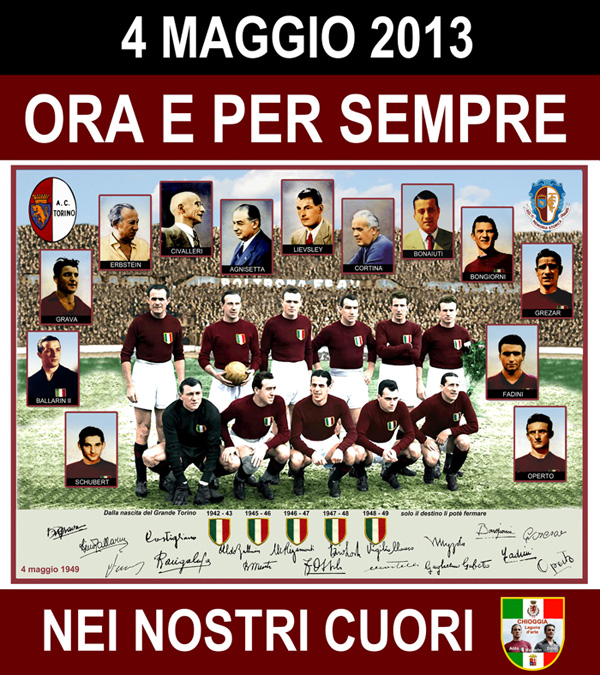
On that fateful day, the Superga Air Disaster occurred.   A plane, carrying the all-conquering Torino team of the 1940’s (famously known as Il Grande Torino) crashed into Superga Hill near Turin, killing 31 people on board, including all 18 players.  The squad were returning home following a friendly match in Lisbon.

Wreckage of the plane.  Image courtesy of attualissimo.it

The Fiat G-212CP plane was heading into a thunderstorm in Turin, and encountered low cloud and poor visibility.  In the area around Superga Hill, visibility was down to just 40m.  The pilot was then forced to descend to be able to fly ‘visually’.  It was during that descent that the aircraft crashed against the base of the rear wall of the Basilica, which stands at the top of Superga.  The causes of the crash were recorded as low clouds, poor radio aids and an error in navigation by a vastly experienced pilot, Pierluigi Meroni.

The task of identfiying the victims fell to ex-national team manager, Vittorio Pozzo.  Many of the bodies had been burnt beyond recognition.  Some could only be identified from documents found in their pockets or by rings on their fingers.  Pozzo was now a journalist for La Stampa, the Turin based daily newspaper.  That evening he wrote "The Torino team is no more.  It has disappeared, it is burnt, it has exploded..."  He ended by saying "...the team died in action, like a group of shock troops in the war, who left their trenches and never came back".

The emotional impact of the crash on Italian sports fans was profound.  The team was the vision of club President Ferruccio Novo.  The side he had created were the darlings of Italy.  With the majority of the team aged just 30 or under, this was a team set to dominate.  Il Grande Torino had won four consecutive league titles (1946-1949) and had virtually clinched a fifth title when the disaster occurred.  Torino played out their four remaining fixtures, shortly after the disaster, consisting mainly of youth team players.  As a mark of respect, their opponents did the same.  Torino were awarded the championship title.


The team holds the record of most consecutive league titles jointly with Juventus at five.  Torino scored 483 goals in five seasons between 1945 and 1949, conceding only 165.  Their captain was Valentino Mazzola, simply known as Captain Valentino.  He captained the team to all five championships and was an inspirational leader.  The oldest player to perish in the disaster was centre-forward Giuseppe Gabetto (33), the youngest was midfielder, Rubens Fadini, aged just 21.  There was some initial confusion after the crash as it was reported that Mazzola did not make the trip.  It was thought that he had remained at home, due to a fever.  Sadly, these reports turned out to be false.

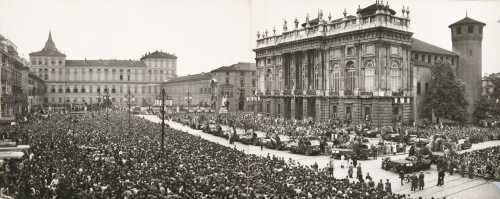
Two days after the crash 500,000 people attended the funeral procession in Turin.  The streets were packed with mourners and the event was transmitted live on national radio.  Coffins were transported through the streets on huge lorries, each bearing the name of the deceased.  That same day over 30,000 people climbed Superga Hill to pay their respects and leave flowers.  On the front wall of the Basilica a plaque commemorates those who died.  Superga remains to this day a site of annual pilgrimage.


Funeral procession in Turin.  Image courtesy of cdn.worldcupblog.org

 This team was truly remarkable.  With the advent of the European Cup in 1955, Torino would have had the chance to become the most successful club side in the world.  They never got that chance and it was Real Madrid who took up their mantle and dominated Europe.

The disaster left the Italian national team (known as the Azzuri) in tatters.  Torino provided 10 players for the Azzuri, who at that time were the current World Cup holders after winning the 1938 World Cup (their second title in a row).  In the five World Cup tournaments that lay ahead, they could only manage the first round in four, they didn't even qualify in 1958!  It wasn't until the 1970 World Cup that they made it past the first round.  Superga's effect lasted longer than many would have imagined.

And what of Torino?  Well, they slowly rebuilt the team but have since been overshadowed by city rivals Juventus.   Since Superga, Juve (backed by the wealthy FIAT empire) have won the league 22 times to Torino's one (a lone Scudetto in 1976).  The balance of power in Turin shows no sign of shifting any time soon.

Wednesday May 4 1949.  A date I will never forget having recently read John Foot’s brilliant book Calcio, a history of Italian football.  Read it.


The plaque at Superga.  Image courtesy of fiveinmidfield.com


I Campioni d'Italia: 'The Champions of Italy'

Valerio Bacigalupo (25)  Goalkeeper
Aldo Ballarin (27)  Full-back
Dino Ballarin (23)  Goalkeeper
Emile Bongiorni (27)  Wing-back
Eusebio Castigliano (27) Midfield
Rubens Fadini (21)  Midfield
Gugliemo Gabetto (33)  Centre-forward
Ruggero Grava (27)  Centre-forward
Giuseppe Grezar (30)  Midfield
Ezio Loik (29)  Wing-back
Virgilio Maroso (23)  Full-back
Danilo Martelli (25)  Midfield
Valentino Mazzola (30) Wing-back
Romeo Menti (30)  Winger
Pierino Operto (22)  Full-back
Franco Ossola (27)  Winger
Mario Rigamonti (26)  Defender
Julius Schubert (26)  Wing-half

R.I.P.


Torino Football Club
In Memory
of its comrades
- the glory of Italian sport -
and those who died with them
in a tragic air disaster

4 May 1949